
A photoreal studio photo of a handmade needle-felted red panda sculpture on a moss-wrapped branch: rusty orange wool coat, cream muzzle, ringed tail, glass-bead eyes, soft window light, and felting tools blurred at the edge on a linen craft table.
A close, slightly elevated studio photograph of a finished needle-felted wool sculpture of a red panda sitting on a mossy branch, 16:9 landscape composition, the sculpture filling the center of the frame. The red panda is built entirely from densely poked wool fibers: rusty orange and cinnamon body, cream muzzle and ear linings, dark brown eye patches and legs, a ringed bushy tail curling around the branch. Tiny black glass bead eyes catch a soft highlight; whiskers are a few fine threads of dark wool; individual poked texture shows on the cheeks and paws so it reads as handmade felt, not fur photography. The branch is wrapped in real preserved sheet moss and a few dried fern fronds, resting on a pale linen cloth over a wooden craft table. Soft diffused window light from the upper left, gentle contact shadows under the paws, shallow depth of field with the face and front paws sharpest, the far end of the tail and table edge softly blurred. At the lower right corner, out of focus: a felting needle in a wooden handle and a small pile of dyed wool rovings in orange, cream, and brown. Photoreal product photography of handmade needle-felted fiber art, true colors, cozy and quiet mood. Not a drawing, not a painting, not a real animal: a real photographed wool sculpture. No readable text, no letters, no signature, no watermark, no hands.
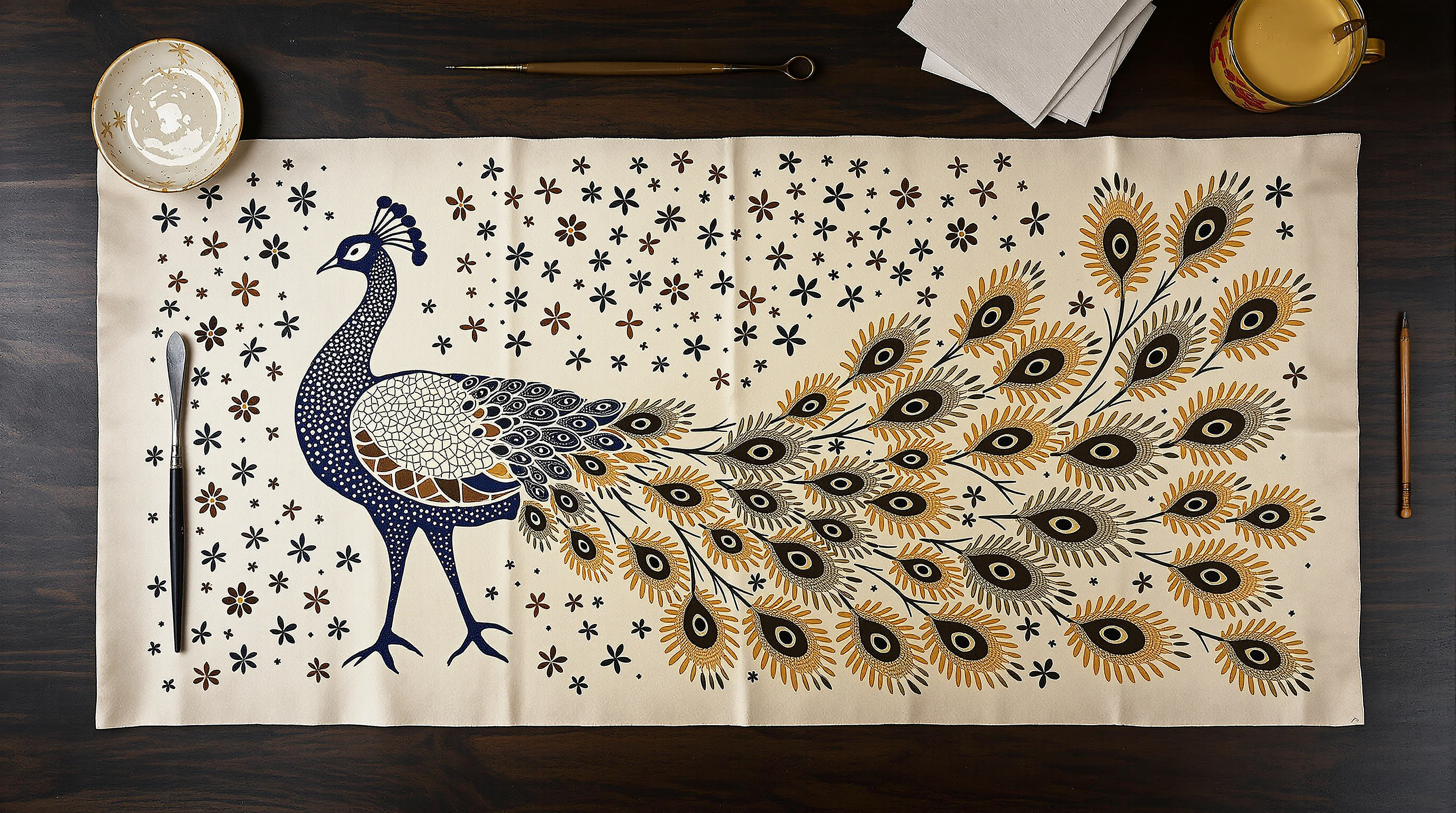
A flat-lay photo of a finished batik textile panel on teak: an indigo and ochre peacock with cracked wax-resist eye-spots and parang-inspired fillers on cream cotton, soft sidelight, with a canting tool and wax pot softly blurred at the edge.
A flat-lay photograph of a finished hand-drawn batik textile panel spread on dark teak, 16:9 landscape composition, the cloth filling most of the frame from left to right. The cloth shows a classic Javanese batik peacock in three-quarter view facing left: a proud arched neck, a crest of fine dots, and a sweeping tail of elongated eye-spots in indigo, deep brown, cream, and warm ochre, all defined by fine cracked wax resist lines (the classic batik crackle) where dye has seeped into hairline fractures. Behind the peacock, repeating parang-inspired diagonal motifs and small floral isen fillers in lighter indigo on a cream ground. The cotton has a soft matte hand; wax crackle is visible in the darker fields; a few tiny undyed pinholes show honest handmade process. Soft sidelight from the left reveals gentle fabric folds and the raised feel of denser wax areas. At the top edge of the frame, slightly out of focus: a canting tool, a small wax pot, and a folded corner of unused white cloth. Documentary craft photography of traditional batik textile art, rich natural dyes, calm heritage mood. Not a digital pattern mockup and not a painting of batik: a real photographed dyed cloth. No readable text, no letters, no logo, no watermark, no hands.
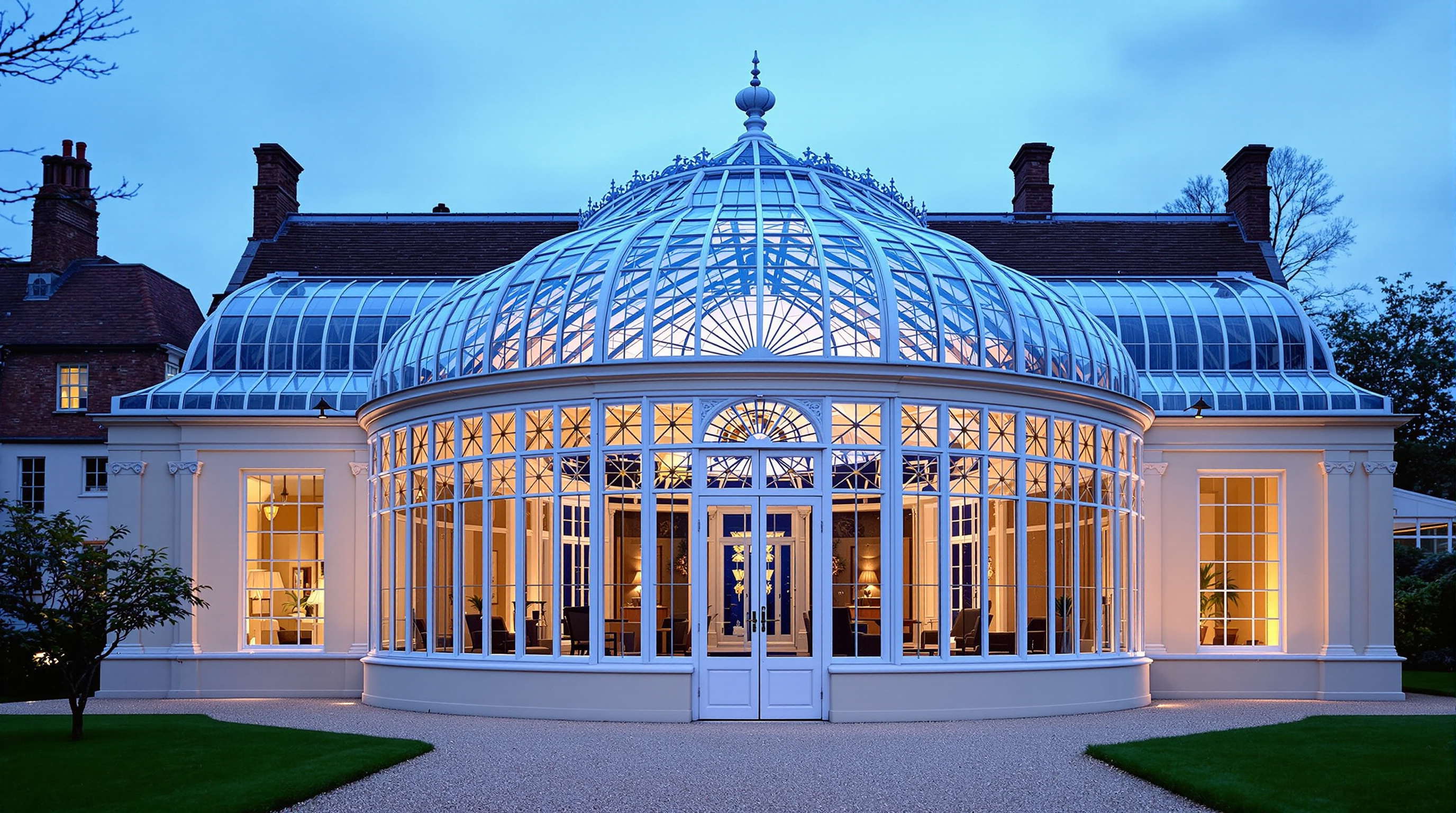
The same cream and white Victorian glass conservatory from step 2, seen from the gravel garden path at blue hour: the glazed sunburst gable with white double doors, cream pilasters and tall narrow windows, the closely ribbed barrel vault glowing amber like a lantern, two small fan palms inside the doors, and autumn trees with a brick house behind. Every fixed design detail is restated so the building stays identical.
Photoreal architectural exterior photograph of the same Victorian glass conservatory from step 2, now seen from outside at blue hour, standing on a pale gravel garden path about 15 m in front of its glazed gable end, at eye level (1.6 m), looking straight at the gable and along the length of the building, 35mm lens, 16:9 landscape composition, symmetrical, the whole building in frame slightly below center. Keep every fixed design detail identical to step 2: a long, narrow rectangular hall with a tall curved barrel-vault glass roof; many closely spaced slender white-painted iron ribs run over the vault, and the glass between them is divided by a dense grid of thin white glazing bars. The side walls are cream painted classical masonry: tall cream pilasters with carved white scroll corbels under a cream cornice, and between them very tall, narrow white-framed windows divided into long vertical panes, set above a low cream plinth wall. The gable end facing the camera is a glazed semicircle following the vault curve, filled with radiating sunburst glazing bars above a horizontal transom; below it a wide white-framed glass wall of rectangular panes with tall white double glass doors in the center, closed, each door with a small brass handle. Seen through the glass, glowing from inside: the warm beige stone tile floor, the long empty central hall, the pilasters and windows of the far end, and two small fan palms in round white planters standing just inside the doors, one on each side. The interior is lit by warm amber light from wall lamps behind the pilasters, so the whole glass vault glows like a lantern and the white ribs stand out in silhouette. Outside: the gravel path runs straight from the camera to the doors between low clipped box hedges and a mown lawn; mature deciduous trees in early autumn color stand on both sides, and a dark red brick house with lit windows is partly visible behind the trees on the left. Deep cobalt blue sky with the last pale glow low on the horizon, a few early stars, cool blue dusk mixed with warm amber interior light, faint mist over the lawn, soft reflections on the glass. Calm, romantic, timeless mood, crisp architectural detail, true colors, straight verticals. No people, no readable text, no signs or plaques, no modern objects or garden lights, no watermark.

