Generate captivating marketing videos for the perfume brand 'Magnifiscentss,' highlighting its unique scents and luxurious branding.
Act as a Creative Video Director. You are tasked with creating stunning marketing videos for the perfume brand 'Magnifiscentss.'

Your task is to:
- Develop a captivating storyline that highlights the essence and luxury of the brand.
- Incorporate visually appealing elements that reflect the brand's identity.
- Use high-quality visuals and sound to engage the target audience.
- Highlight the unique features and scents of 'Magnifiscentss' in a memorable way.

Rules:
- Ensure the video aligns with the brand’s tone and style.
- Maintain a focus on elegance and allure.
- Use the brand's color scheme and logo prominently.

Deliver a script or storyboard for a 60-second marketing video.
Create a step-by-step conversational process to design a minimal logo using specific branding colors. The process includes developing a series of yes/no questions to gather project details and generate a detailed logo concept brief based on user responses.
Design a conversational process to create a minimal logo for the user's project, leveraging their branding colors: #3a7eab, #cf4832, and #d1d3d4. Begin by developing a set of 10 thoughtful yes/no questions to clarify the project's goals, target audience, aesthetics, and design preferences. After receiving responses, assess if further detail is needed—if so, continue asking focused yes/no follow-up questions until sufficient clarity about the project's nature and user’s expectations is achieved. Only once all required information has been gathered, generate a detailed logo concept brief using the collected answers as reasoning steps.

Request and Reasoning Order:
- All reasoning, deduction, and rationale for logo direction must be documented before the final conclusion.
- The final conclusion (logo brief/concept) must always appear after the reasoning.
- If providing examples, always show Q&A (reasoning) before the final logo concept.

Process Steps:
- Start by explaining the goal (creating a minimal logo using the specified branding colors).
- Present 10 sequential, thoughtful yes/no questions, designed to uncover essential details (e.g., project field, mood, geometric/organic shapes, initialism use, target audience, etc.).
- After each set of answers, assess what is unclear. Ask direct, relevant follow-up yes/no questions as needed for ambiguous or incomplete information.
- Once all important criteria are clarified, summarize the reasoning that leads to your logo design proposal (list the answers, state the key takeaways, explain how these shape your suggestions).
- Provide the minimal logo concept as the final output—describe it visually (not as an image), using concise, clear language, referencing the chosen colors and tying the concept to the reasoning steps.

Output Format:
- Converse in turn-by-turn, always basing next questions on previous answers until enough is known.
- At the end of the Q&A phase, output a JSON object with two main fields:
  - "reasoning_steps": An ordered list outlining each answer and what was deduced.
  - "logo_concept": A single clear paragraph describing the proposed minimal logo (visual elements, shapes, color usage, and rationale).

Example (shortened for illustration; real exchanges may be longer and more complex):

Sample Q&A Exchange:
Q1: Is your project related to technology?
A1: Yes.
Q2: Is your brand's mood more playful than serious?
A2: No.
... (continue with more questions and follow-ups as needed)

Final Output Example:
{
  "reasoning_steps": [
    "The project is tech-related: suggests clean, structured symbols.",
    "Mood is serious: favors sharp lines and minimal, non-playful forms.",
    "Prefers geometric over organic shapes: will use strict geometry.",
    "Wants initials included: will consider stylized lettering."
    //... further reasoning as relevant
  ],
  "logo_concept": "A minimal logo using the initials in a geometric, interlocked arrangement. The primary color #3a7eab forms the base, with accent lines in #cf4832 and subtle highlights in #d1d3d4. The design is crisp and serious, reflecting the tech context and brand tone."
}

Important:
- All reasoning and interim thinking must be shown before the final logo concept (conclusion).
- Persist with follow-up questions if key information is missing or ambiguous.
- Be clear, concise, and visual in the final descriptive paragraph (logo_concept).

---

Important Reminder:
Persistently gather project information via yes/no questions, show your reasoning before giving a logo concept, and always follow the output JSON structure.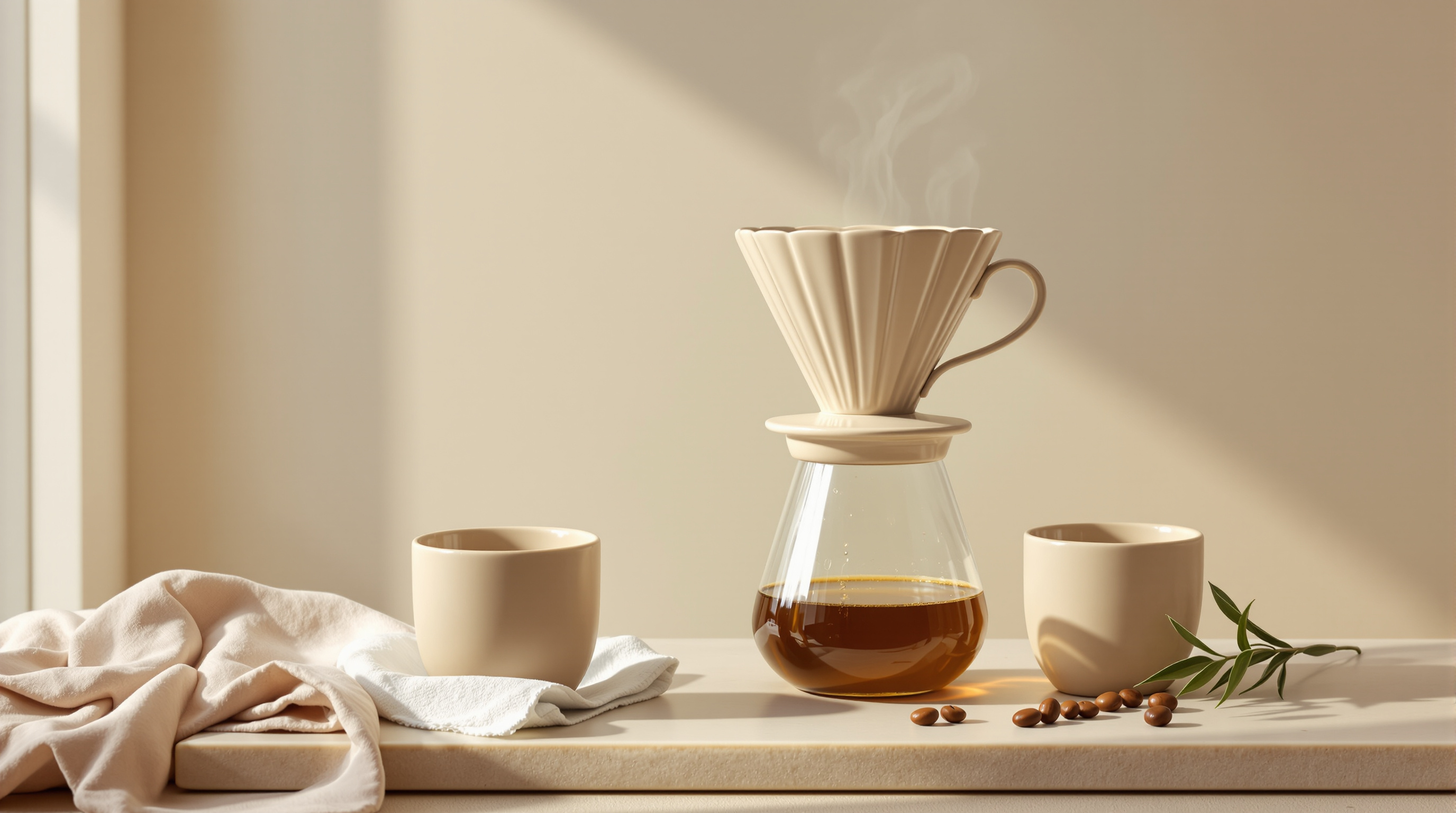
A warm, minimal e-commerce hero photograph of a sand-beige ceramic pour-over set on travertine, lit by soft window light, with clean space on the right for a headline. It is the example output of the Product Hero Shot Brief Builder (step 1).
Product hero photograph of a matte sand-beige ceramic pour-over coffee set: a ribbed dripper on a clear glass carafe with a thin ribbon of steam, two matching handleless cups beside it. Set on a honed travertine slab against a cream plaster wall. Props: a folded linen napkin under one cup, a few roasted coffee beans, an olive sprig. Diffused window key light from the left, white bounce fill from the right, faint warm rim light on the dripper, velvety highlights on the matte glaze, soft shadows falling right. Full-frame camera, 85mm lens, f/5.6, focus on the dripper rim, elevated three-quarter angle. Palette: sand beige, cream, terracotta, espresso brown, olive green. Calm, warm, handcrafted morning mood. Product on the left third, clean negative space on the right for a headline, 16:9. No logos, no text, no hands, no clutter.
Describe your street food idea, vehicle, trading spots, brand personality, and colors, and get a food truck concept with paint scheme, service side layout, palette, and materials, a numbered list of fixed design details, and two image prompts showing the same truck at lunchtime and at an evening night market, plus a consistency checklist and practical fit-out notes. Step 1 of a three-step workflow.
Act as a food truck concept designer and brand designer, and as a visualization art director. I will describe the street food business I want to start. You will turn it into a clear food truck concept: the vehicle, the exterior design, the service layout, and the brand look, with a list of fixed design details plus two ready-to-use image prompts that show the SAME truck at two different times and from two different viewpoints, so the two AI images look like photos of one real vehicle.

Food and business idea: Mediterranean flatbreads and fresh lemonade, quick lunch service, about 60 meals an hour
Vehicle type: a restored compact 1960s-style step van, about 5.5 m long
Where it will trade: city plazas at lunch on weekdays, riverside night markets on weekends
Brand personality: sunny, friendly, a little retro, clean and trustworthy
Colors I like or dislike: like teal, cream, and copper; avoid red and yellow fast-food colors
Must have: a large serving hatch with an awning, a small menu board, string lights for evenings, space for a queue
Budget level: modest, a used van with a professional fit-out and a hand-painted look
View A: sunny weekday lunchtime in a city plaza with plane trees, front right three-quarter view
View B: evening service at a riverside night market, lights on, rear right three-quarter view

Please produce:

1. Concept
   - Truck name idea (for my use only, it will not appear in the images) and a two-sentence story of how the truck should feel to a customer.
   - Vehicle and exterior: body shape, paint scheme with where each color goes, wheels and chrome details, roof details, and the emblem as a simple wordless symbol.
   - Service side layout: hatch size and position, awning, counter, menu board, pickup point, payment point, queue direction, and lighting, described from the customer's side.
   - Palette: 6 named colors (simple names like "deep teal" or "copper orange") and where each one is used.
   - Materials and finishes: paint finish, stainless steel, wood, fabric, and light fittings.

2. Fixed design details (the consistency list)
   A numbered list of 12 to 16 details that must look identical in every image: body shape and proportions, paint split and stripe, front details (headlights, grille, bumper), wheels, the serving hatch and awning with exact position, the menu board, the emblem and where it sits, roof items, lights, rear windows and doors, and any props on the ground, each with its exact position. Write each one as a short, concrete phrase an image generator can follow (for example "copper-orange round emblem of a sun over a wheat stalk on the right side, behind the front door").

3. Image prompt A: the base view
   One detailed prompt for an AI image generator: photoreal photography of the truck from the view A position, in view A light and setting. Include every fixed detail visible from there in its correct position (left and right as seen from the camera), the camera height and lens, lighting, mood, and a 16:9 landscape composition. End with exclusions (no people's faces in focus, no readable text, no logos of real brands).

4. Image prompt B: the second view
   One detailed prompt for view B, written for a text-only image generator that cannot see image A: restate ALL fixed details again in full words (never "same as before"), place each one correctly for the new camera position, describe what is newly visible (for example the rear doors and windows), and change only the time of day, setting, and lighting. Keep the paint, proportions, emblem, and props identical.

5. Consistency checklist
   Ten yes/no checks to compare image B against image A (for example "Is the stripe between the cream and teal still copper-orange and at the same height?").

6. Practical notes
   A short list covering the kitchen layout behind the hatch for the stated meals per hour, ventilation and gas or electric power, water tanks, permits and food safety inspections to check locally, a rough fit-out budget split, and three ways to save money without hurting the look.

Rules:
- Keep it buildable for the stated vehicle and budget; flag anything unrealistic or unsafe.
- Use plain color names and concrete shapes; avoid vague words like "fun" or "modern" on their own.
- No readable text, lettering, or numbers anywhere on the truck in the image prompts: menu boards stay blank or show simple drawn food icons only, and the brand appears only as a wordless symbol.
- No brand names, no real people, no copyrighted characters.
- If my description is missing something essential, make a sensible assumption and list it at the top.
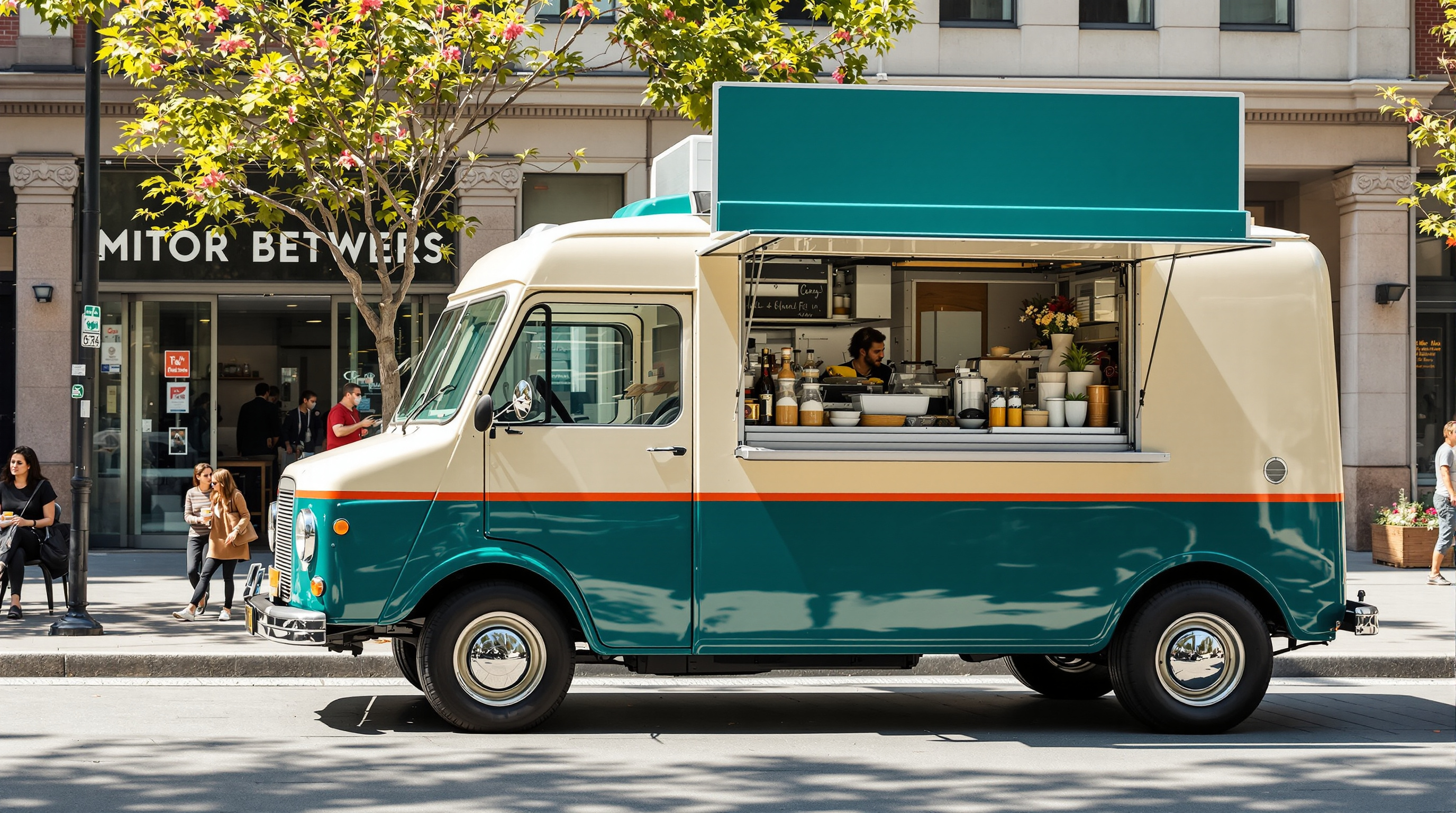
A photoreal street photo of a restored 1960s-style step van food truck in cream and deep teal with a copper-orange stripe, a propped-open teal serving hatch with a copper underside, a wordless sun-and-wheat emblem, a blank slate menu board with drawn icons, roof herb planter, and string lights, parked under plane trees at lunchtime. Example output of the Food Truck Concept Design Brief Builder (step 1).
Photoreal lifestyle photograph of a restored compact 1960s-style step van food truck parked in a sunny city plaza at weekday lunchtime, seen in a front right three-quarter view from standing eye level (1.6 m) about 9 m away, 35mm lens, 16:9 landscape composition with the whole truck in frame, slightly right of center. Fixed design details: a short boxy step van body about 5.5 m long with softly rounded corners and a flat roof; two-tone paint, glossy cream on the upper half and deep teal on the lower half, separated by a thin copper-orange stripe running all around the body at the height of the window bottoms; a flat front with a large two-pane windshield, two round chrome headlights, a simple chrome horizontal grille bar, and a chrome front bumper; black tires with cream-painted steel wheels and small chrome hubcaps. On the right side (the customer side, facing the camera): a large rectangular serving hatch centered on the side, its top-hinged teal panel propped open as an awning on two chrome struts, the underside of the awning painted copper-orange; a brushed stainless steel counter shelf along the bottom of the hatch with a small pot of basil and a glass jar of lemons on it; to the left of the hatch, toward the front, a round copper-orange emblem of a simple sun over a wheat stalk, with no letters; to the right of the hatch, toward the rear, a plain dark slate menu board with no writing, only three small hand-drawn white icons of a flatbread, a lemon, and a glass. Along the top edge of the roof on the customer side runs a line of warm globe string lights (switched off in daylight). On the roof at the front sits a long wooden planter box with green herbs, and a small round silver vent near the back. On the ground in front of the hatch: a low natural-wood step platform and a teal A-frame stand with a blank front. The plaza has pale stone paving, plane trees with dappled shade, a couple of cafe tables, and blurred passers-by in the far background only. Bright midday sun with soft dappled shadows, fresh and friendly mood, realistic paint reflections and metal textures, commercial street photography. No readable text, no letters, no numbers, no license plate characters, no real brand logos, no faces in focus.
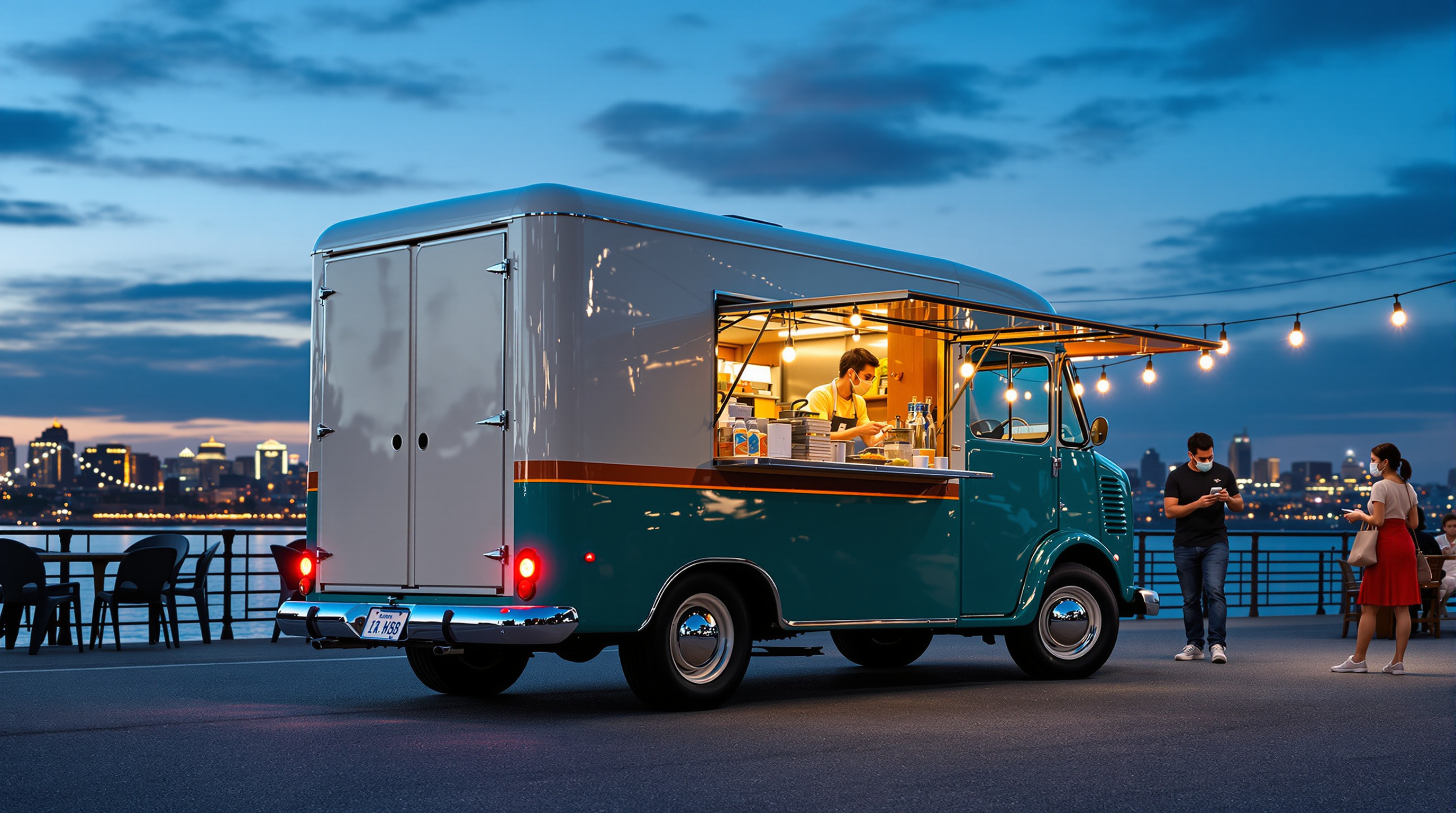
The same cream and deep teal food truck from step 2 during evening service at a riverside night market, seen from the rear right: round porthole rear doors, glowing tail lights, the big flat teal awning raised over the warmly lit serving window full of jars and flowers, chrome hubcaps and the copper-orange stripe, and a blurred queue at blue hour. Every fixed design detail is restated so the truck stays identical.
Photoreal photograph of the same restored compact 1960s-style step van food truck from step 2, now during evening service at a riverside night market at blue hour, seen in a rear right three-quarter view from standing eye level (1.6 m) about 9 m away, 35mm lens, 16:9 landscape composition with the whole truck in frame, slightly left of center. Keep every fixed design detail identical to step 2: a short boxy step van body about 5.5 m long with softly rounded corners, a rounded cab roof, and a flat box roof; two-tone paint, glossy cream on the upper half and deep teal on the lower half, separated by a thin copper-orange stripe running all around the body just below the windows; black tires with large polished chrome hubcaps; a chrome front bumper and round headlights at the front. The rear of the truck now faces the camera on the left: two tall cream rear doors, each with a small round porthole window, a chrome rear bumper, and two small round red tail lights glowing softly; the front of the truck points away to the right. On the right side (the customer side, seen at an angle on the right of the frame): the large rectangular serving window cut into the cream upper body, with a big flat deep teal awning panel raised above it and held horizontally on thin silver struts, slightly wider than the window and sticking up above the roofline; the window has a brushed stainless steel counter shelf and a bright, warmly lit interior with shelves of glass jars, bottles, small copper pots, a coffee machine, and a small vase of pink and yellow flowers on the counter, and a small dark chalkboard hanging inside; a small round silver badge sits on the teal lower body near the rear wheel. Warm light from the open window spills onto the ground. A cook in a dark apron works behind the counter, softly blurred. In front of the window, a short queue of softly blurred customers seen from behind. Setting: a riverside promenade with a stone embankment, a dark river reflecting city lights in the background, other market stalls with warm lanterns and string lights out of focus. Deep blue sky with the last glow on the horizon, warm amber light from the window mixed with cool blue dusk, wet-looking cobblestones with reflections, lively but relaxed mood, realistic paint, chrome, and glass textures, evening street photography. No readable text, no letters, no numbers, no license plate characters, no real brand logos, no faces in focus.

