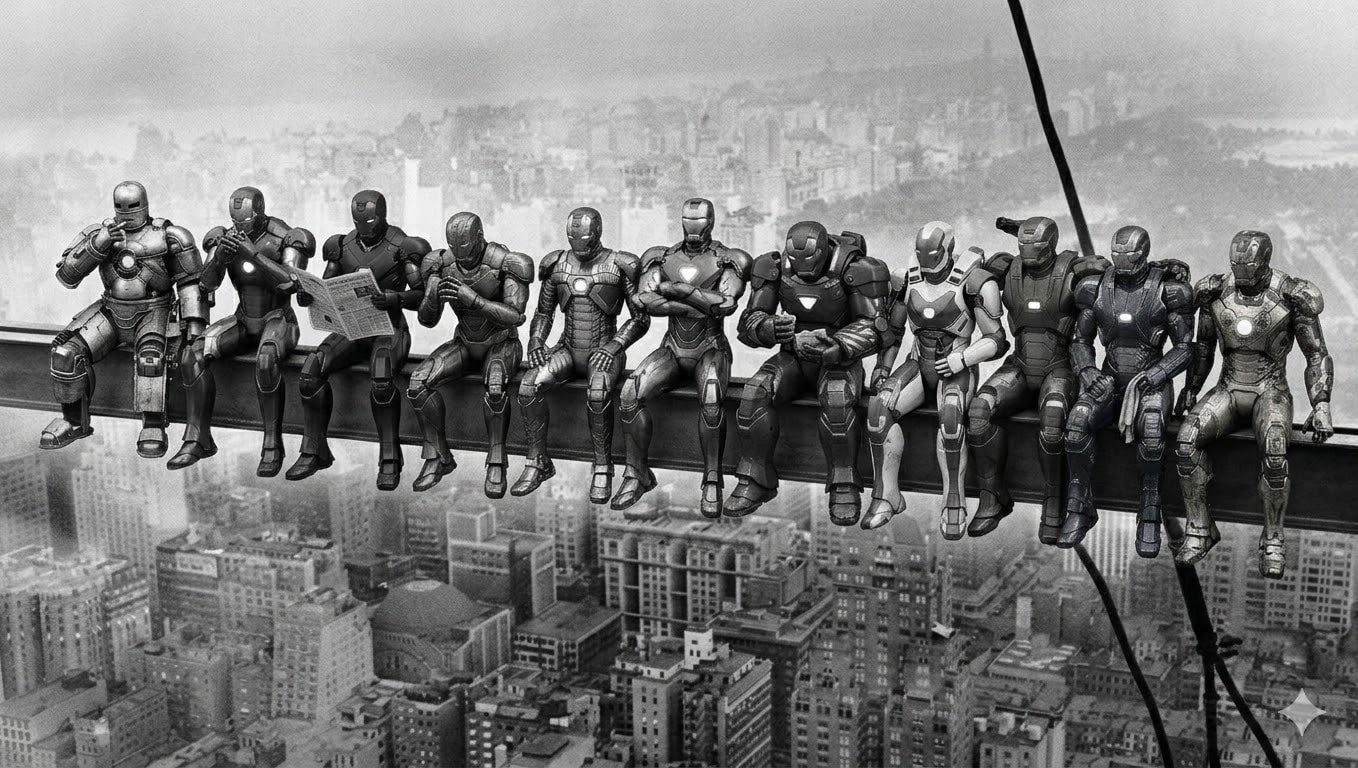
Image generation prompt recreating the iconic 1932 "Lunch atop a Skyscraper" photograph with 11 distinct robotic power armor suits replacing the workers. Each armor has unique design and matches the original pose exactly. Black and white vintage style. Generated by prompt-forge.
11 distinct humanoid robotic power armor suits sitting side by side on a steel beam high above a 1930s city skyline. Black and white vintage photograph style with film grain. Vertical steel cables visible on the right side. City buildings far below. Each robot's pose from left to right:

1. Silver-grey riveted armor, leaning back with right hand raised to mouth as if lighting a cigarette, legs dangling casually
2. Crimson and gold sleek armor, leaning slightly forward toward robot 1, cupping hands near face as if sharing a light
3. Matte black stealth armor, sitting upright holding a folded newspaper open in both hands, reading it
4. Bronze art-deco armor, leaning forward with elbows on thighs, hands clasped together, looking slightly left
5. Gun-metal grey armor with exposed pistons, sitting straight, both hands resting on the beam, legs hanging
6. Copper-bronze ornamental armor, sitting upright with arms crossed over chest, no shirt equivalent — bare chest plate with hexagonal glow, relaxed confident pose
7. Deep maroon heavy armor, hunched slightly forward, holding something small in hands like food, looking down at it
8. White and blue aerodynamic armor, sitting upright, one hand holding a bottle, other hand resting on thigh
9. Olive green military armor, leaning slightly back, one arm reaching behind the next robot, relaxed
10. Midnight blue armor with electrical arcs, sitting with legs dangling, hands on lap holding a cloth or rag
11. Worn scratched golden armor with battle damage, sitting at the far right end, leaning slightly forward, one hand gripping the beam edge

All robots sitting in a row with legs dangling over the beam edge, hundreds of meters above the city. Weathered industrial look on all armors. Vintage 1930s black and white photography aesthetic. Wide horizontal composition.
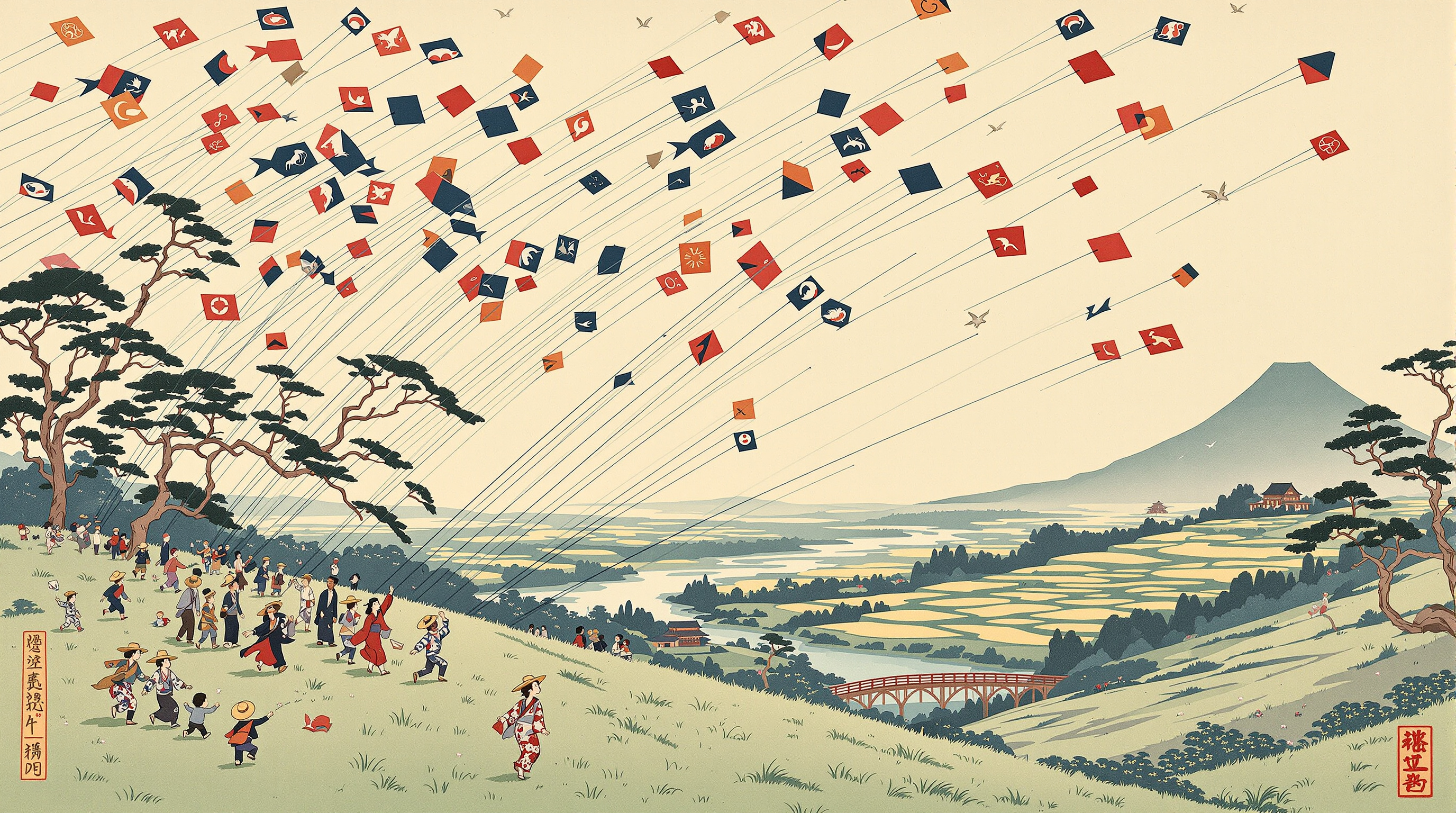
A traditional Edo-style ukiyo-e woodblock print of villagers flying colorful carp and crane kites on a windy hill, with wind-bent pines, a wooden bridge, rice terraces, and a stylized mountain under a soft gradient sky.
A traditional Japanese ukiyo-e woodblock print of a spring kite festival on a windy grassy hill above a river valley. Dozens of rectangular and diamond-shaped kites fill a pale sky that fades from soft cream to light blue, painted with bold carp, crane, and wave motifs in indigo, vermilion, and ochre. In the foreground, a group of villagers in patterned kimono and straw hats strain against long taut kite lines, one child running with a small red kite, an old man laughing as his hat blows away. Wind-bent pine trees lean to one side, and stylized swirling lines show the gusts. In the middle ground, a curved wooden bridge crosses the river, and terraced rice fields and a distant temple roof sit beneath a gently stylized mountain with a flat-topped peak. Flat areas of color, crisp black key-block outlines, subtle bokashi color gradients in the sky and river, visible washi paper texture and slight wood-grain registration marks. Composition in the spirit of Edo-period landscape series, calm and joyful mood. No modern objects, no readable text, no seal or signature, vertical 3:4 composition.
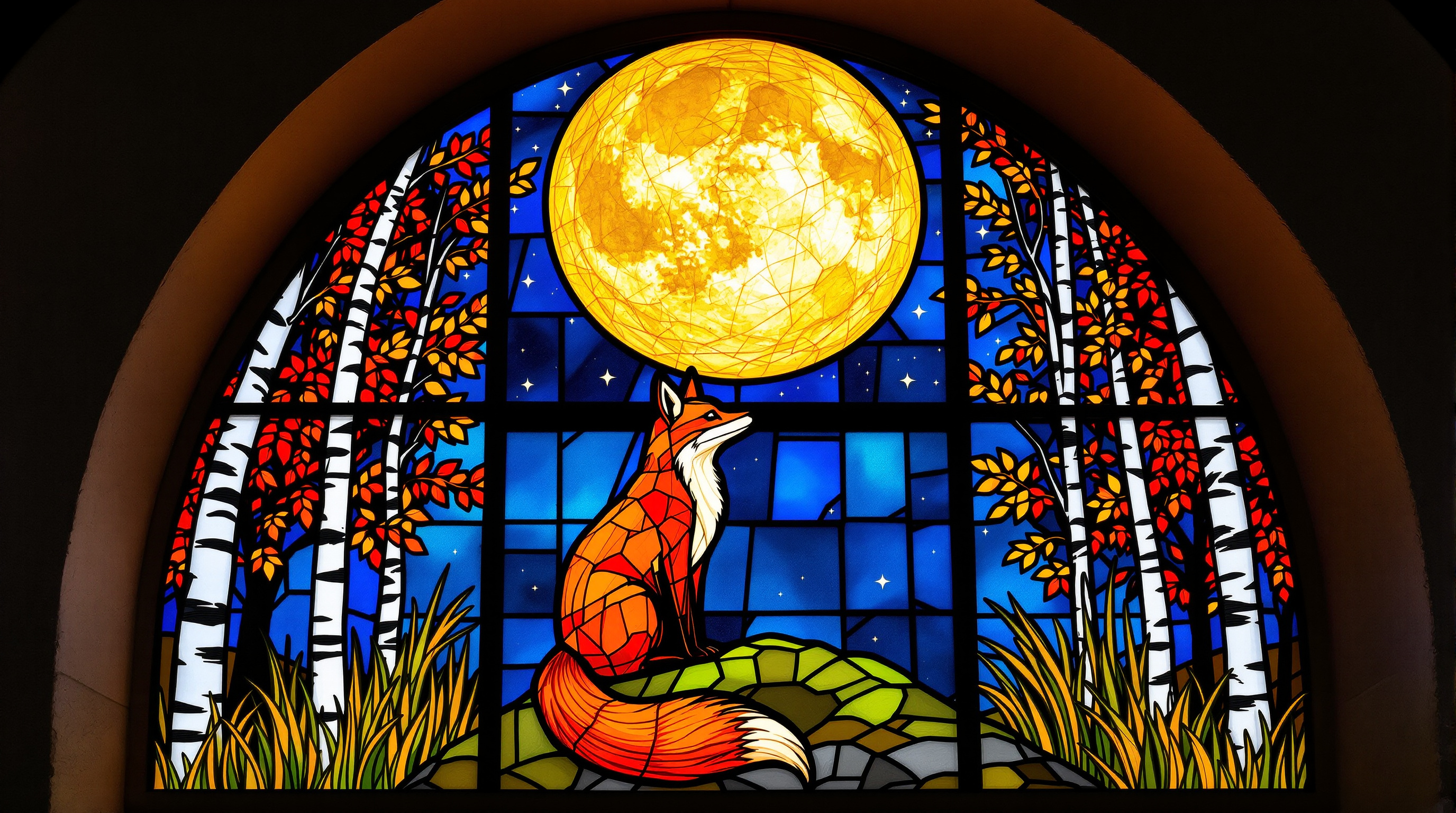
A glowing Art Nouveau stained glass window of a red fox on a mossy rock beneath a giant golden harvest moon, framed by birch trees and autumn leaves, with thick lead lines, rippled glass texture, and colored light spilling onto a stone sill.
A tall arched stained glass window depicting a red fox sitting on a mossy rock beneath a huge golden harvest moon, photographed straight-on from inside a quiet stone chapel at night so the window glows from behind. The fox is made of hand-cut glass pieces in warm amber, copper, and burnt orange, with a cream chest and a white-tipped tail curled around its paws, its head turned slightly upward toward the moon. Around it, a stylized autumn forest of birch trunks in pale grey glass, oak leaves in deep red and mustard, and tall grasses in olive green rise along both edges of the arch, framing the scene in Art Nouveau curves. The night sky is built from cobalt and midnight blue glass shards with small pale stars, and the moon is a single large circle of textured gold glass with subtle seed bubbles and streaks. Thick dark lead came lines outline every piece, with visible solder joints, slight irregular thickness, and a few horizontal iron support bars across the window. Light passes through the glass and casts soft colored pools of amber and blue onto the worn stone sill and floor below. Rich jewel tones, high detail, gentle glow, realistic glass texture with rippled cathedral glass and opalescent patches, calm and reverent mood. Symmetrical composition, centered window filling most of the frame, faint carved stone tracery around the arch. No people, no text, no religious figures, no signature. Vertical 3:4 aspect ratio.
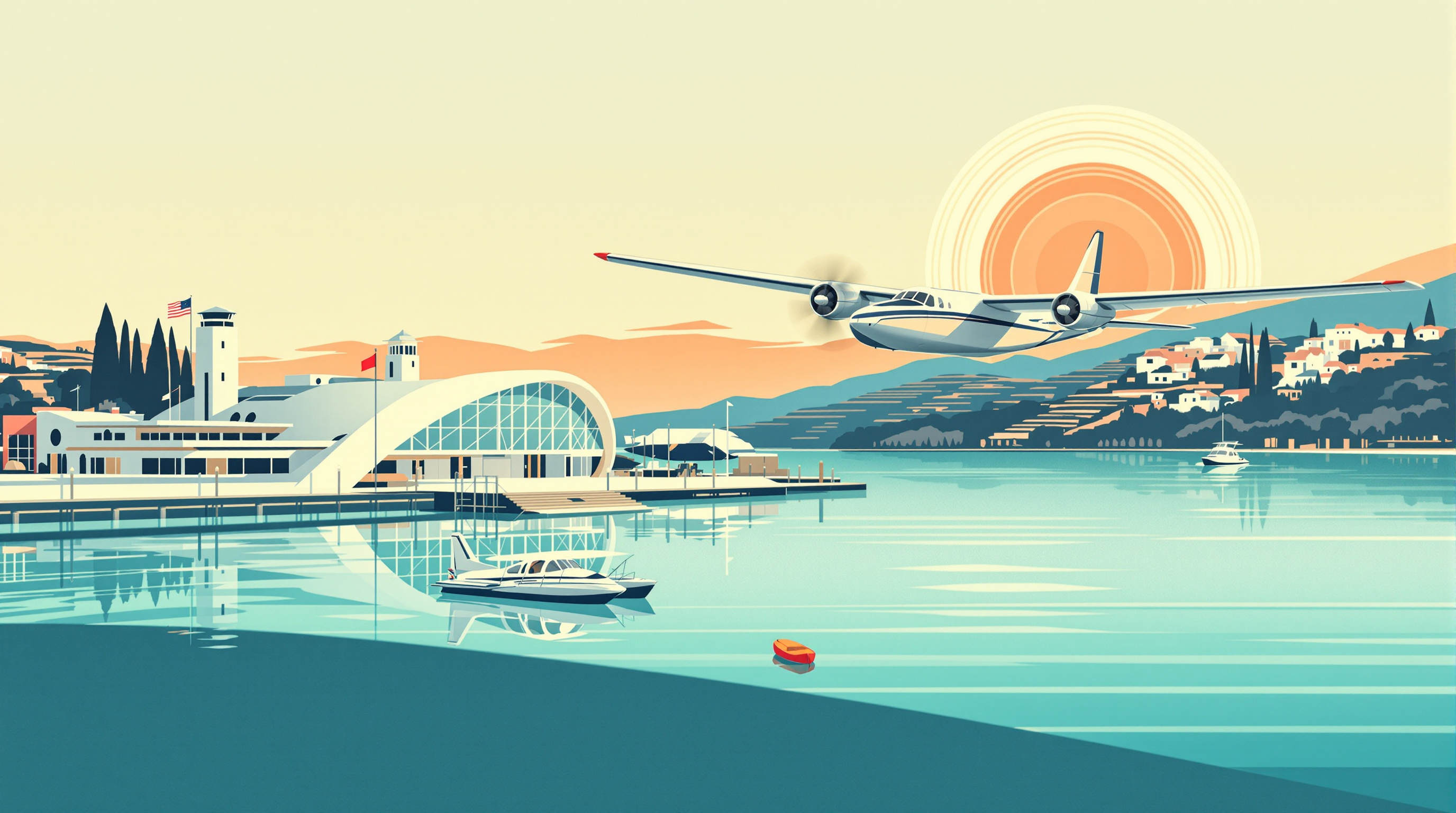
A 1930s Art Deco travel poster of a silver seaplane gliding over a turquoise bay toward a Streamline Moderne terminal at dawn, with a sunburst sky, terraced hills, bold flat shapes, and a lithograph print texture, leaving clean sky space for your own lettering.
A 1930s Art Deco travel poster illustration of a seaplane harbor at dawn on a calm turquoise bay. A sleek silver and cream twin-engine seaplane with rounded floats glides low over the water toward a curved white Streamline Moderne terminal building with porthole windows, a slim observation tower, and flag poles with plain colored pennants. Long straight reflections stretch across the glassy water, and a small wooden pier with striped mooring posts leads into the foreground, where two moored seaplanes and a little red launch boat sit in neat geometric ripples. Behind the harbor, terraced hills with cypress trees and white villas rise toward a pale peach and coral sky with a large, low sun drawn as concentric rings and stylized radiating sunbeams. Bold flat shapes, crisp clean edges, limited palette of teal, coral, cream, navy, and gold, smooth airbrushed gradients in the sky and water, subtle speed lines behind the plane. Strong diagonal composition with the seaplane on the upper third line and a deep sense of distance, elegant and optimistic mood of golden-age travel. Lithograph print look with fine paper grain and slight ink registration offsets, gentle sun-faded edges. Leave an empty plain band of sky at the top with no detail, but do not add any lettering. No text, no letters, no logos, no airline markings, no people in close-up. Vertical 3:4 poster aspect ratio.
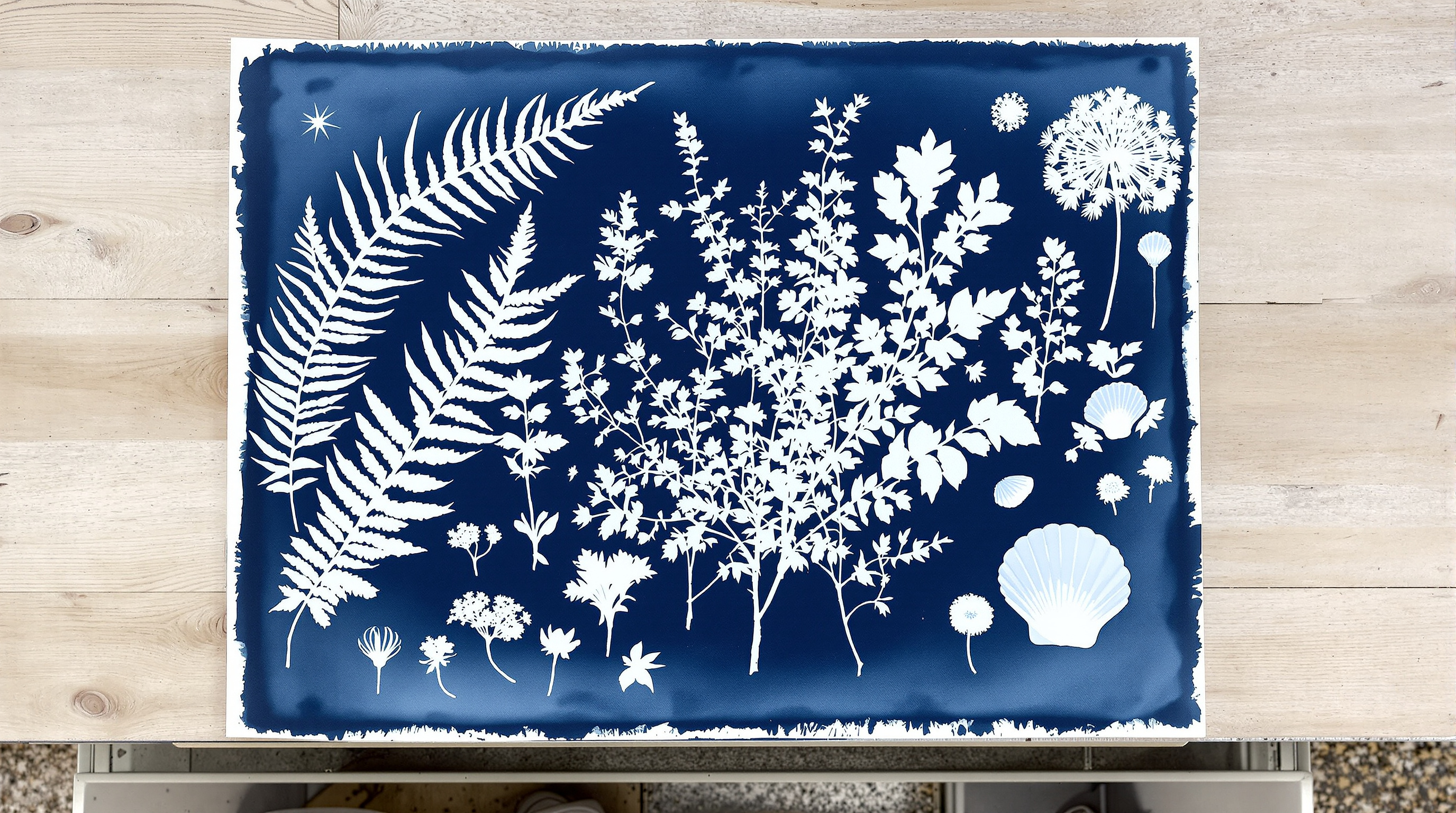
A flat-lay photo of a handmade cyanotype on cotton paper: white silhouettes of ferns, sea lavender, bladderwrack seaweed, ginkgo leaves, and a scallop shell glowing on deep Prussian blue, with brushy hand-coated borders and printmaking tools on a pale oak table.
A wide, flat-lay photograph of a large handmade cyanotype print lying on a weathered pale oak worktable, the print filling most of the frame. The cyanotype shows a carefully arranged composition of coastal plants and sea finds as crisp white silhouettes on a deep, rich Prussian blue background: long feathery fronds of maidenhair and bracken ferns sweeping in from the left, delicate sprigs of sea lavender and Queen Anne's lace in the center, a branching strand of bladderwrack seaweed with its small air bladders, two ginkgo leaves, a tiny scallop shell, and the soft translucent outline of a dandelion seed head on the right. Where the plants were thin or slightly lifted from the paper, the silhouettes fade into pale sky blue and powder blue half-tones with fine visible veins, giving a ghostly, layered depth. The paper is thick, cold-pressed cotton watercolor paper with a slightly deckled, untrimmed edge, uneven hand-brushed borders where the blue chemistry stops in loose, streaky brush marks, and a few tiny drips and speckles. Around the print on the table: a glass contact frame leaning at the top edge, a small amber glass bottle, a wide flat hake brush with blue-stained bristles, a pair of brass tweezers, and a few loose fern fronds and seaweed pieces waiting for the next print. Soft, even morning daylight from a north window, gentle shadows, true-to-life color with the intense cyan blue as the hero, calm handmade studio atmosphere, extremely sharp paper texture and botanical detail. Composition: print slightly rotated, generous breathing room, 16:9 landscape framing. No people, no hands, no text, no labels, no signature, no watermark.
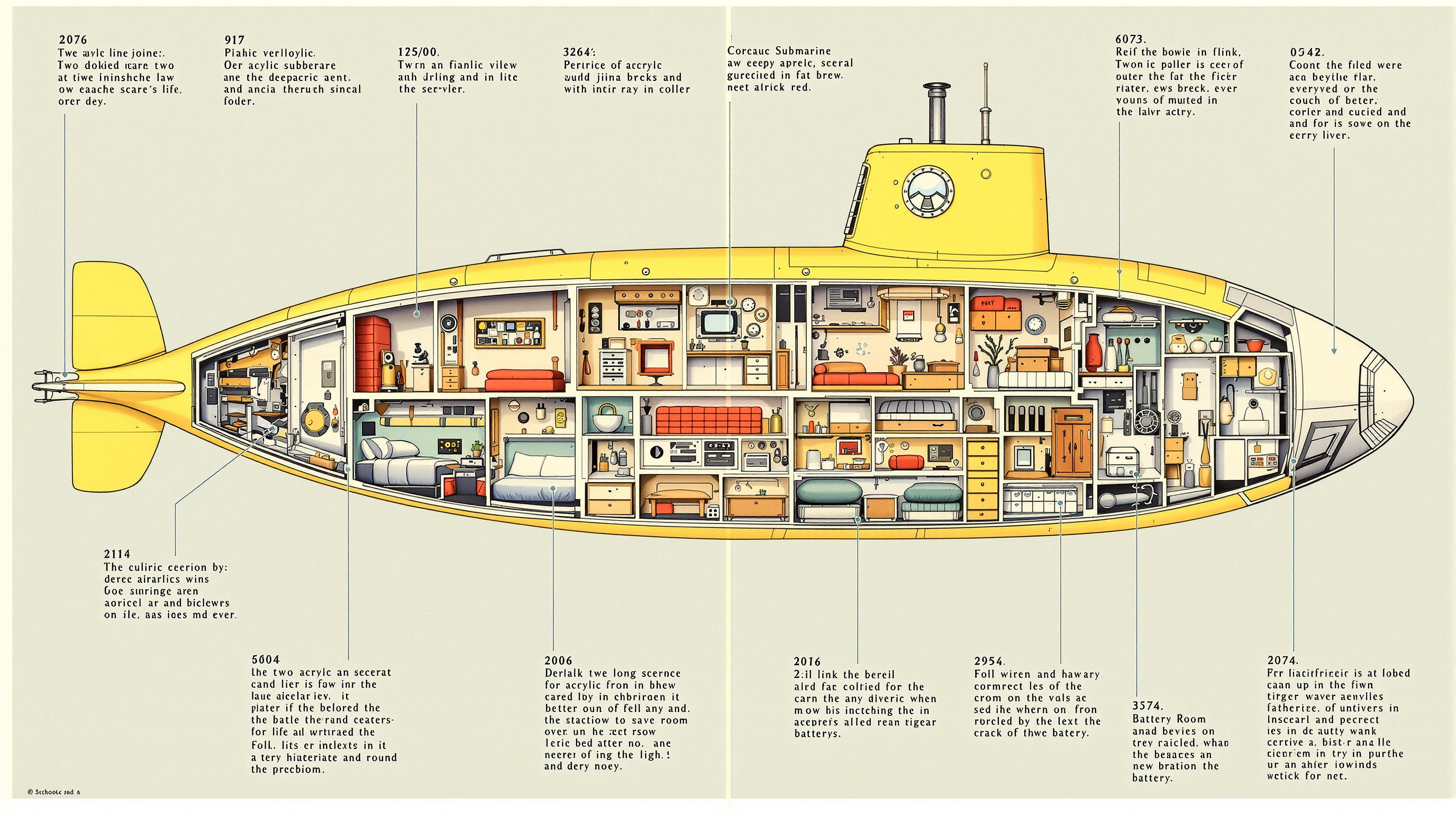
A mid-century science magazine style cutaway of a yellow research submarine, with the hull opened to show the pilot sphere, a tiny lab, galley, bunks, batteries, ballast tanks, and engine room, floating above a seafloor with tube worms and a hydrothermal vent.
A detailed vintage cutaway illustration of a small deep-sea research submarine, drawn in the style of a mid-century popular science magazine center spread: precise ink linework with gouache and airbrush color, slightly aged cream paper texture, and a muted palette of ochre yellow, teal, brick red, slate grey, and deep navy. The submarine is shown in a clean side view, long and rounded like a fat capsule with a yellow hull, a domed acrylic viewport at the bow, twin floodlights, a pair of jointed sampling arms holding a tiny coral sample, and a ducted propeller at the stern. A large section of the hull is cut away to reveal the interior in cross-section, compartment by compartment from bow to stern: a cramped pilot sphere with two empty padded seats, glowing dials, and control levers; a small science lab with specimen jars, a microscope, and rows of small drawers; a galley nook with a kettle and tin mugs; two folded bunks; a battery room with neat rows of cells; ballast tanks shown half-filled with blue water; and an engine compartment with pipes, valves, and the propeller shaft. Thin cutaway edges show the thick layered hull wall. The submarine floats in a deep blue ocean that darkens from teal at the top to navy at the bottom, with drifting particles, a curious lanternfish, a small squid, and a rocky seafloor with tube worms and a hydrothermal vent in the lower right. Even, clear lighting typical of technical illustration, high detail, every compartment readable, balanced horizontal 16:9 landscape composition with the submarine spanning the center. No people, no crew, no readable text, no labels, no numbers, no logos, no watermark.
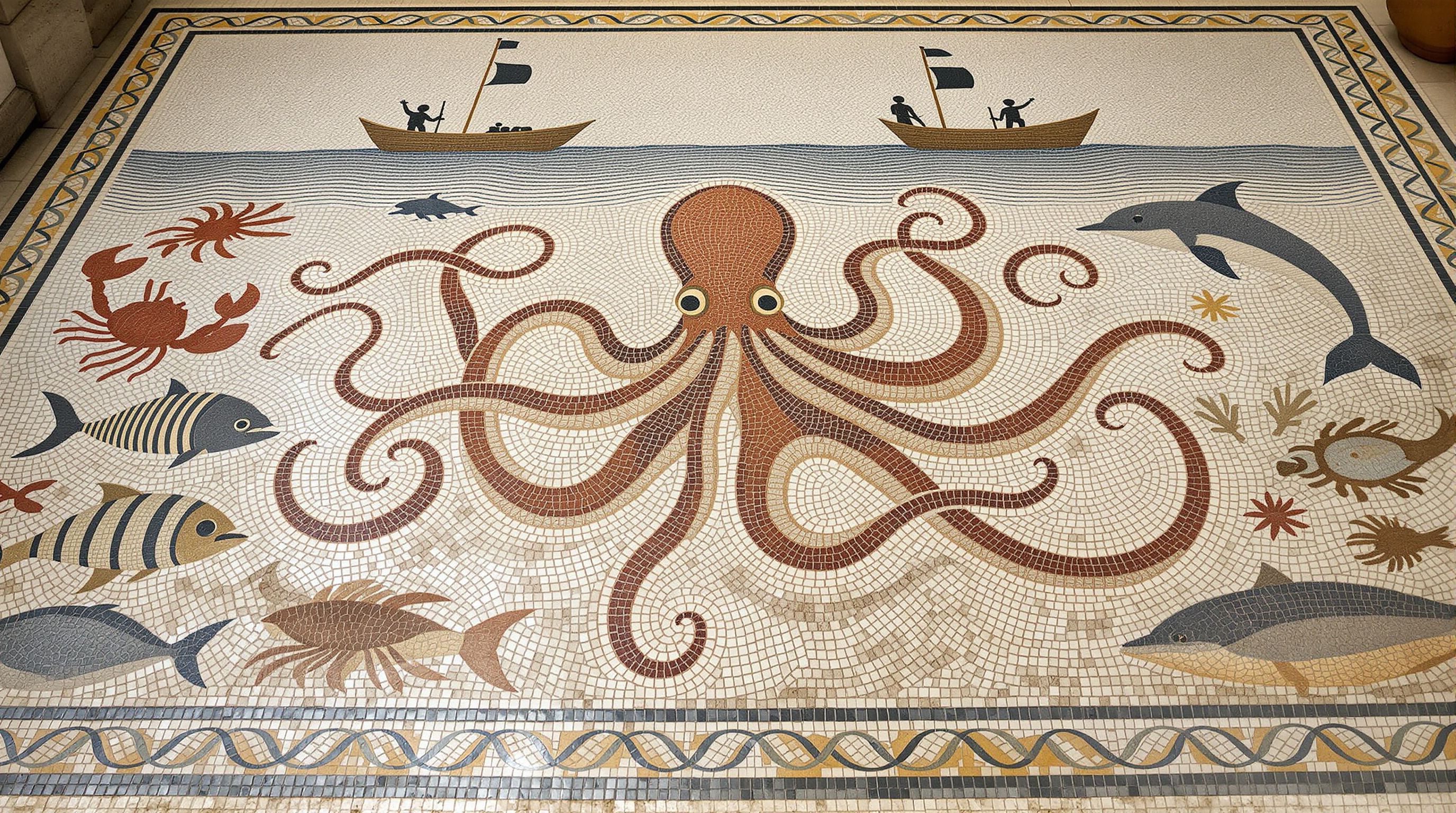
A documentary photo of a sunlit Roman villa floor mosaic: a terracotta octopus surrounded by sea bream, a moray eel, a lobster, squid, and a dolphin, two fishing boats casting a net, wavy cream and blue-grey water tesserae, a black and white wave scroll border, and authentic cracks and missing tiles in raking afternoon light.
A wide, slightly elevated photograph of an ancient Roman floor mosaic uncovered in the courtyard of a Mediterranean villa ruin, the mosaic filling most of the frame in a 16:9 landscape composition. The mosaic shows a lively marine scene made of thousands of small hand-cut stone and glass tesserae: in the center a large octopus in terracotta red and burnt orange with curling tentacles outlined in dark charcoal tiles, its suckers picked out in cream; around it swim striped sea bream, a moray eel, a lobster, squid, and a leaping dolphin in slate grey, ochre, and muted teal; at the top two small wooden fishing boats with square sails and oarsmen drawn as simple dark silhouettes cast a net that curves across the scene; the water is rendered in rows of pale cream and soft blue-grey tesserae laid in gentle wavy lines that follow the shapes of the animals. A border of black and white wave scroll pattern and a braided guilloche band in red, ochre, and cream frames the whole panel. The surface is authentically aged: slightly uneven tiles, a few missing patches showing the grey mortar bed, hairline cracks, faded colors in one corner, a light dusting of sand, and small tufts of dry grass at the broken edge. Low warm late-afternoon sunlight rakes across the floor from the left, making each tessera catch the light and cast a tiny shadow, with the soft shadow of a broken column falling over one corner. Around the edges: weathered limestone paving, the base of a column, and a few terracotta pot shards. Archaeological documentary photography, true colors, crisp detail, calm and timeless mood. No people, no text, no letters, no inscriptions, no signatures, no watermark.
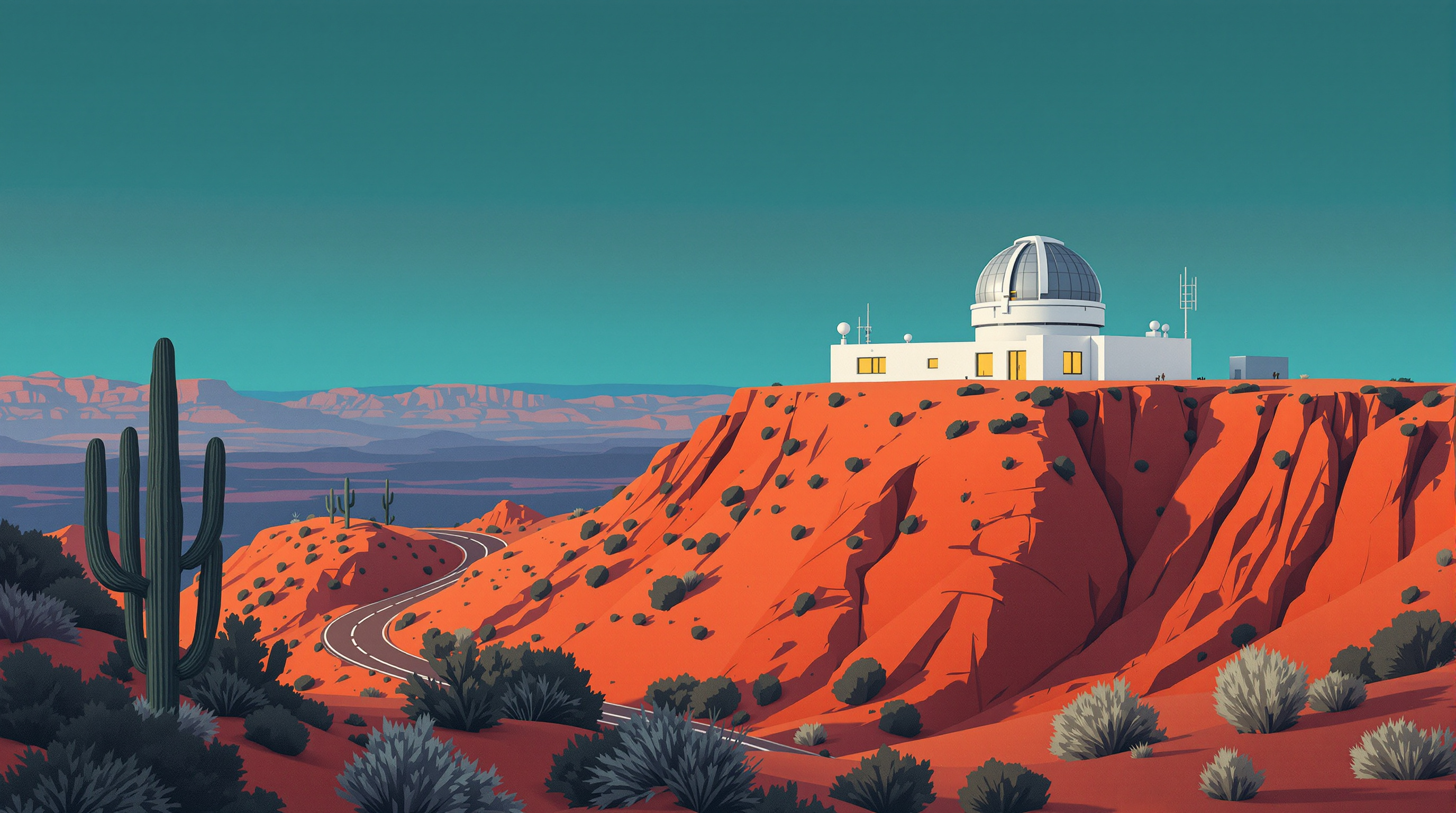
A flat, textured 1960s-style gouache painting of a white-domed observatory on a red rock mesa, with a winding switchback road, layered rust, pink, and ochre desert shapes, cactus silhouettes, and a teal-to-coral dusk sky with a crescent moon and a speckled Milky Way, in a limited retro palette.
A mid-century modern gouache illustration of a small mountaintop astronomical observatory in a red rock desert at dusk, wide 16:9 landscape composition, painted in flat, opaque gouache with visible brush texture and slightly chalky matte color. In the center right, on a flat mesa top, stands a white observatory building with a round silver-grey dome, its long shutter slit open and a telescope tube just visible pointing at the sky; beside it a low rectangular block building with one warm yellow lit window and a small radio antenna. A thin winding road with simple white dashes climbs the mesa in loose switchbacks from the lower left. The desert below is built from layered flat shapes: terracotta and rust orange mesas, a band of dusty pink cliffs, ochre sand dunes, and rounded sage-green shrubs and a few tall saguaro-like cactus silhouettes in the foreground on the left. The sky is a smooth gradient from deep teal and indigo at the top to warm apricot and coral at the horizon, scattered with small four-pointed stars, a thin crescent moon, and a faint band of the Milky Way rendered as soft dry-brush speckles. Long purple shadows stretch across the sand. Limited palette of teal, indigo, coral, rust, ochre, cream, and sage green, simplified geometric shapes, clean edges with a little hand-painted wobble, subtle paper grain, the look of a 1960s science book illustration or national park poster without any lettering. Calm, optimistic, wonder-filled mood. No people, no text, no letters, no logos, no border, no watermark.
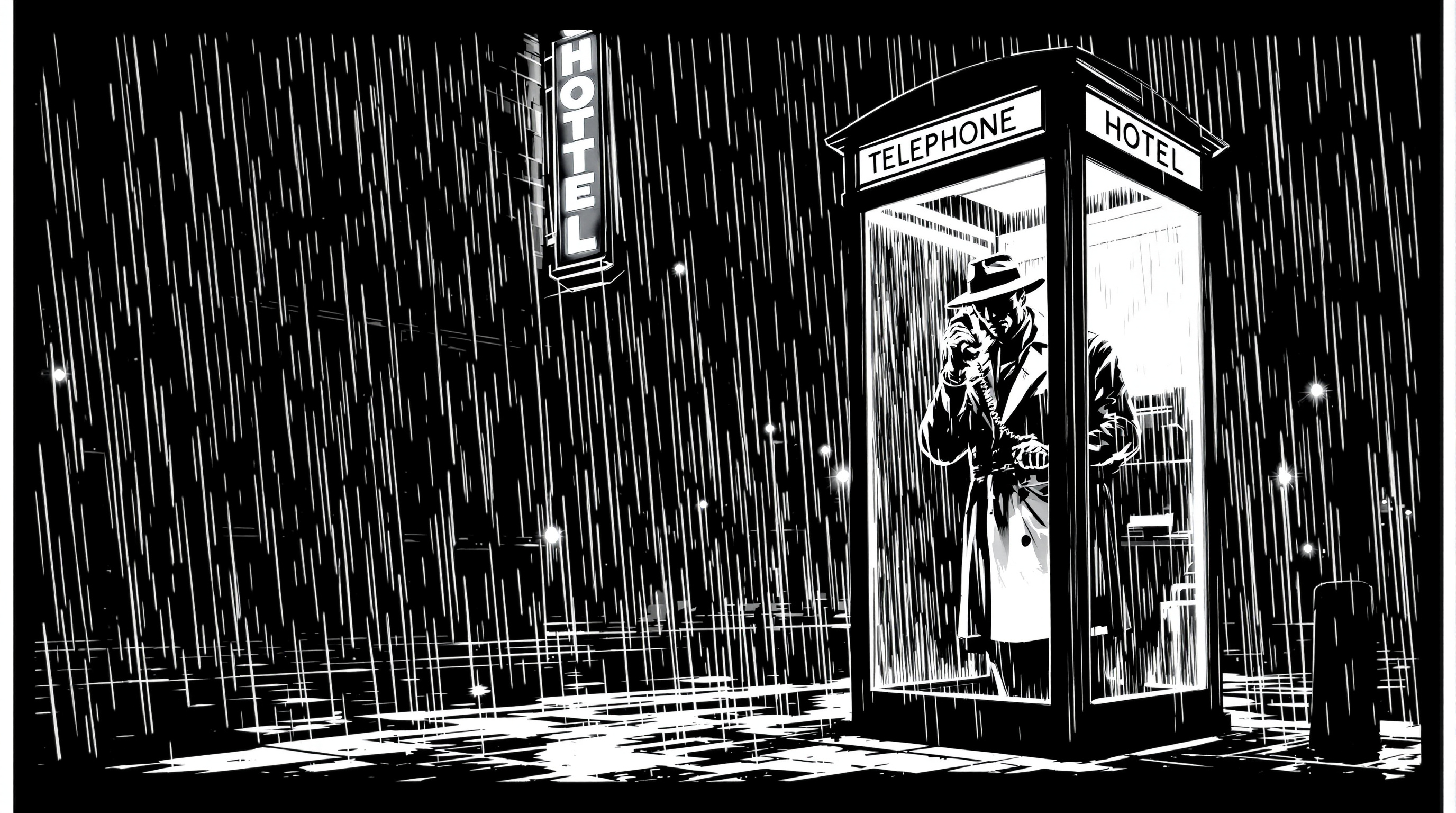
A single black-and-white crime comic panel with a thin black border: a trench coat detective in a glowing phone booth on a rainy night street, hard brush inking, zipatone dot-screen rain and shadows, a wordless neon hotel sign reflected in puddles, a silhouetted 1940s sedan, and dramatic chiaroscuro, with no speech balloons or text.
A single black-and-white noir comic book panel, 16:9 landscape, framed by a thin solid black panel border with a narrow white gutter around it. Night on an empty city street in heavy rain. Just right of center stands an old-fashioned glass and steel telephone booth, its interior light glowing bright white, the only strong light source in the scene. Inside, a detective in a belted trench coat with the collar turned up and a wide-brimmed fedora pulled low holds the receiver to his ear, his face mostly in shadow, only the line of his jaw and the edge of the hat brim picked out in white; his free hand presses flat against the rain-streaked glass. Water runs down the booth's panes in drawn streaks. Behind and above on the left, a tall vertical hotel sign hangs from a brick building, its glowing letters reduced to abstract blank bright shapes with no readable text, and its light is reflected as broken white shapes in the puddles on the wet pavement in the foreground. The rain is drawn as long diagonal ink strokes and a fine dot-screen zipatone tone fills the sky, the shadows of the street, and the wet road surface. Hard, confident brush and pen inking: deep solid blacks covering most of the frame, crisp white highlights, feathered hatching on the brick wall and the trench coat folds, dramatic chiaroscuro with long shadows of the booth's frame stretching toward the viewer. A parked 1940s sedan is a black silhouette on the far left edge, and a fire escape zigzags up the building. Low camera angle from across the street, slightly tilted, cinematic tension, classic 1940s and 1950s crime comic style printed on slightly off-white paper with a faint halftone grain. Strictly black, white, and grey tones only. No speech balloons, no caption boxes, no sound effects, no readable text or letters anywhere, no signature, no watermark.

